Showing posts with label title sequence. Show all posts
Showing posts with label title sequence. Show all posts
Thursday, 21 January 2016
Filming, Editing, Final Piece and Evaluation (Drama)
For this title sequence I wanted to strip down and figure out what the film is really about. The film, for me, is about the coming of age of the protagonist and revolves around his knowledge and what he can learn. The film's essential prop is the chalkboard. I think this title sequence, although basic, links the audience with the turning point of the film - when the protagonist writes on the chalkboard. To improve this I think I could have less movement of the chalkboard and perhaps better equipment for terms of filming, for example the camera quality and the height of the tripod. To improve I would also add a soundtrack that fits a drama genre in addition to more diegetic sounds of typical school life, such as scraping chairs across floors, writing on the chalkboard and bells. Again, with this piece my main issue was timing, to fit in all the credits within 30 seconds, I think that had the title sequence been atleast a minute I wouldn't have struggled as much. I could also set this sequence within a classroom, and watching students leave the room and then pan closer to the chalkboard. I would also perhaps try a stop motion as I don't like the hands within the sequence. I could also try and use different colours of chalk depending on the credit.


Law & Order UK
I chose this title sequence so I could get a range of the subgenres of drama.
The title sequence begins slowly with a voiceover while the title font slowly fades in from black, presenting a sense of mystery but also power with the voice over. The soundtrack builds very quickly and presents a sense of urgency. Clips are overlaid onto imagery that represents police, London and courts which sets up a sense of location and historical period (current day). The music feels very patriotic and might fill the audience with a sense of empowerment and trust within the characters.
Good Will Hunting
The sequence opens with an abstract background, it's only when the audience looks closer that they can see it's copies of books repeated like a kaleidoscope effect. The kaleidoscope effect reminds me childhood, for me the film represents the coming of age, so I think that this effect is well used and representative of it's character. The music is very soft suggesting childhood again, the music becomes progressive throughout, perhaps suggesting the character will do the same. The font is basic and centrally aligned to not distract the audience. The cinematography is very tight and shows close ups, which could suggest a sense of intimacy with the character. The final shots of this sequence are from a high angle perspective, to perhaps make the characters look inferior.
Forrest Gump
The title sequence is very slow paced, following a feather, which could signify innocence and delicacy perhaps suggesting this of the character. The font in this title sequence is very basic and centrally alligned so that it doesn't distract the audience from what is going on in the background. The soundtrack is very soft and delicate, matching with the feather, I think that this combined with the one take of this sequence makes it flow well and sets the mood and atmosphere of the film and also the drama genre. The colour palette again is very soft and delicate, which adheres to the codes and conventions of the drama genre.


Wednesday, 20 January 2016
Filming, Editing, Final Piece and Evaluation (Thriller)


I think the main issue I had with this piece is that I think the other idea would've worked better. My original idea was to show the seven deadly sins, which feature heavily in the film Se7en. Another issue I had was that the title sequence to Se7en is so iconic that I found it hard to steer away from the title sequence I knew well. To improve this piece I think I should add sound, specifically a soundtrack that builds pace and tension and also add diegetic sound of a clock ticking to add a sense of urgency and time to the sequence. I had already made this title sequence when we were told not to use font from a computer, my way to improve that woul be to write on a mirror and show it at a canted angle, or perhaps show the character out of focus but the font within focus. Another issue I had was timing, I think I found it difficult to get all the credits in, and set up an idea of the character, the mood and atmosphere for the piece at the same time. I think that another issue I had was lack of 'good' equipment. All of this is filmed off a Fujifilm finepix AV10, which isn't great quality for shooting, it has auto focus which is annoying for doing close ups and pulling focus in some shots would've helped add tension. I like the effects I've added to the footage, I think to improve the edits, I could've also filmed more footage and over laid two clips and changed the opacity so that they gave a more uneasy feeling for the audience.
Panic Room
The diegetic sound in this title sequence fits that of a busy city, matching what the cinematography shows us of wide shots of buildings. The soundtrack fastens and starts the build tension, the camera movements become faster at this point, showing more busy traffic and from high angles suggesting power, towards the end of the clip there is a low angle shot perhaps suggesting the characters lack of power within the diegesis. I like the way the font fits with the buildings, almost as if they are the buildings or are like billboards. The pace of the editing begins slow, and then fastens with the soundtrack. I don't think there are any signifiers to suggest what happens in the film, I think this title sequence is used to set the scene within the film.
Tuesday, 19 January 2016
Gone Girl
Gone Girl Title Sequence from Faris Abass Jibril on Vimeo.
The non diegetic sound track sound is slow and keeps pace with the slow paced cuts, this shows the mystery and drama of the piece, accompanied with the voice over, it contrasts and evokes the audience to feel conflicted. The shots at the beginning of the sequence are close ups from a higher perspective, suggesting that we are looking down on the character and are superior to that character. It also suggests an intimate relationship with the two characters as the male character strokes the female characters hair. The character's eye contact in this scene isn't broken, which could suggest power over the other character, or perhaps links the audience to this particular character. The mood and ton of the piece suggested by the light and saturated colour palette and the cross fade transitions suggest a softer atmosphere to the film, showing the 'perfect' life. The following shots show a town, suggesting a trapping environment as the town is isolated - this also suggests that the male character are alone.
Catch Me If You Can
In this title sequence you can see the influence from Saul Bass' work with the use of lines and cut out images. This animation challenges the audiences depth of field, for example the last shot showing the two main characters running. The title sequence summarises the film in a humorous way that is simple for the audience. This is also shown by the non diegetic soundtrack that slowly builds throughout the title sequence and fastens towards the end of the sequence. The editing flows well into each shot type as it turns into the scene. This title sequence almost feels like a short animation, as the titles fit into the mise en scene as the become roads and cords for lifts.
Conventions of Drama genre
- Realistic storyline of life and situation
- character development
- dramatic sounds
- revolves around families
- high key lighting
- slow paced editing
- emphasises on the mise en scene
- close ups of characters
- thematic
Codes and Conventions for Thrillers
- Low key lighting
- fast paced editing - quick cuts
- shadows/dark/contrast
- mirrors
- sharp objects such as weapons/knives/razor blades
- building music
- diegetic sounds - breathing/door creaking
- cinematography - angles and tightly framed
- crosscutting
- trapping environment
- filmstroke - fine & grainy
Monday, 18 January 2016
Audience
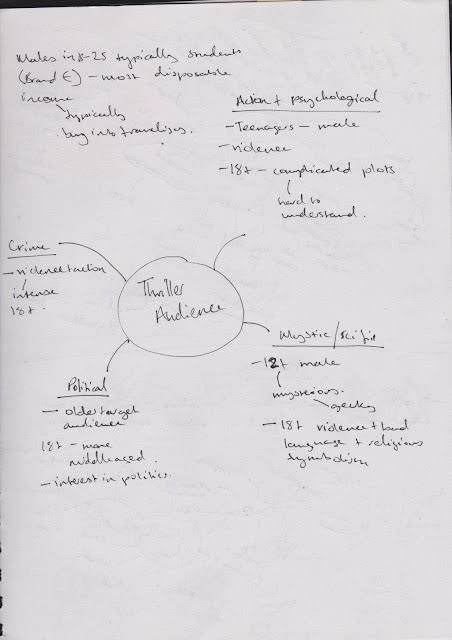
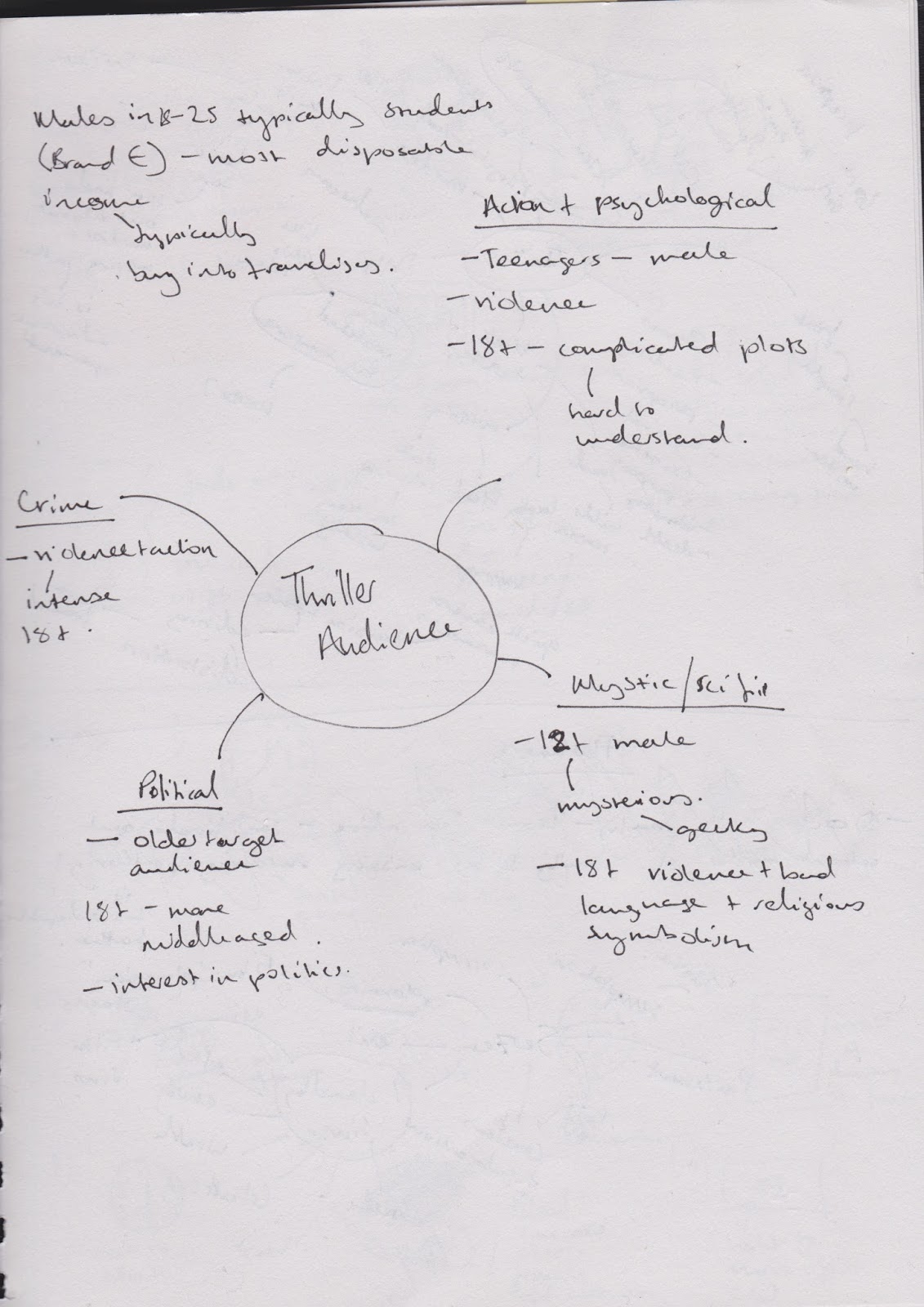
Thrillers are divided into sub-genres. Thrillers are primarily watched by Males in the 18-25 region, who are typically students (Occupation brand E) and have the most disposable income and typically buy into franchises.




Enigma Code
Roland Barthes Enigma Code
Enigma - illusive - secret
A text portrays mystery to draw an audience in to pose questions and as such become intrigued in the piece.
For instance, a murder mystery will often not reveal the identity of the killer until the end of the story which poses the question,'who is the murderer?'
Narrative/enigma codes
Categorised as:
Enigma - illusive - secret
A text portrays mystery to draw an audience in to pose questions and as such become intrigued in the piece.
For instance, a murder mystery will often not reveal the identity of the killer until the end of the story which poses the question,'who is the murderer?'
Narrative/enigma codes
Categorised as:
- Hermeneutic Code - Voice of Truth. : Element in a story not explained and therefore exists as an enigma for the reader, raising questions
- Proairetic Code - Voice of Empirics : Tension built up leaving the audience guessing what will happen next
- Semantic Code - Voice of Person : Any element in text suggests meaning by way of connotation which the story suggests
- Symbolic Code - Voice of Symbol : Wider level of semantic code, organises semantic meanings into broader and deeper sets of meaning. New meaning arises out of opposing and conflict ideas
- Cultural Code - Voice of Knowledge : Looks at the audiences wider cultural knowledge, morality and ideology




Subscribe to:
Posts (Atom)