Showing posts with label FMP Research. Show all posts
Showing posts with label FMP Research. Show all posts
Sunday, 22 May 2016
Storyboarding
Typically I dislike storyboarding as I find it repetitive and unnecessary to do at length, however I wanted to push myself in FMP into storyboarding more. I researched into how to storyboard properly as on set I have found it hard to follow my own drawings.
After looking at those videos and developing my own way that I would feel comfortable with drawing. I found that drawing all the frames gave me more awareness of the set and what is in the frame and if it's necessary or could be framed another way. It also helped me to create a detailed shot list and number on my copy of the script what line should be spoken at which camera angle and saved time in the shooting process.
small arrow - direction of action/character
big arrow - movement of camera
cropped in/out of frame - zoom in/out

3 artists thing


Studio Ghibli films are one of my favourite films, they are always beautifully drawn and composed; they always feel nostalgic and have a sense of time passing and appreciation of life in them. I specifically like the way Miyazaki uses binary oppositions in colouring in the frames of his films.


David Fincher's style can be described as an auteur, his centrally alligned frames in his films are aesthetically pleasing and the yellow/blue colouring shows a sickly, gloom setting.

Misrach, the inspiration for the True Detective title sequences uses symmetry in his photography which is aesthetically pleasing and also uses soft colour palettes to add to this.


I attempted to replicate shot types by these photographers/film makers / animators, some of which were more successful than others. For example, I like the photo of a dark figure standing by the water edge and think that it is very similar to Misrach's own. I think by 'copying' the artists work it makes me think about how the artist created those shots and think more about lighting and composition of the frame; this has made me think more about my own shots that I will use in my film and heavily consider lighting and composition of the frame in the storyboarding process and while on set.
Saturday, 21 May 2016
Poster Analysis


From this I learnt about how the frames should be composed and where the lighting would be in frames in relation to what is the main object in the frame. This has also given me different ideas of perspective and to perhaps use different colouring. I could also develop film stills or the court room drawings we plan to have as posters to advertise our film.
Friday, 20 May 2016
Dawn and Lila research
From our previous project, we used Buffy and Dawn from Buffy the Vampire Slayer. In episodes 'The Body' and 'Blood Ties' which I analysed their relationship. In 'The Body' Buffy becomes more maternal and like a mother - Dawn is a bratty teenager and unsympathetic as the group is sad 'I still know how to pee', and gets herself into danger with her naivety.
'Blood ties', I like the argument in her Dawn's room 'Get out! get out! GET OUT!' and the subtextual argument heavily influenced the argument in the bedroom.
I started to think of other sisterly relationships that I was influenced by, in Daria, Daria and Quinn are two sisters that are binary opposites and therefore conflict is born and they argue with each other. 'Daria Please' in Quinn the Brain.
I also picked out specific traits from Gossip Girl younger sister Jenny Humphrey as she can come across as a 'bratty bitch' as well as Lizzie McGuire.
I also looked at the Powerpuff Girls as they have arguments and gang up on each other as they are opposites of each other, especially shown through the colours that they are, they are advancing colours not complimentary.
The Parent Trap twins show that they are binary opposites that creates conflict especially at the beginning of the film where they don't get along and have subtextual arguments.
Frozen sisters Anna and Elsa are similar to the characters of Dawn and Lila as Lila assumes the parental role when their parents pass away.
From this I learned that we had a specific type of character and it was also helpful as I was able to tell the actresses what characters from popular films and TV shows to channel in their performance.
I thought it was peculiar that these tv shoes and films of sister relationships were mainly from the 90s and I thought about new tv shows such as Adventure Time, Amazing World of Gumball and Regular Show that show brother relationships. It provoked the thought of what happened for it to change? Feminism was strong in the 90s with popular media such as Spice Girls, Tatu, Destiny's Child, TLC and Bewitched. This might be down to the fact that fighting for gender equality isn't just the problem anymore, there's islamaphobia, transphobia, black lives matter.
Monday, 25 April 2016
London Riots
http://www.bbc.com/news/uk-14449675
http://www.bbc.co.uk/news/uk-19077349
It was suggested in feedback that we should look into the London Riots.
Research into the London Riots further proves the reasoning why I initially didn't look into it - the riots were caused by an unjust death in the black community by a police officer who claimed the boy was armed when he was not. While the riots did include theft or 'looting', it was in protest rather than an organised robbery/burglary that was not provoked.
However, I thought that the stereotype of young teenagers in black hoodies is relevant in crimes that involve theft such as the London Riots and is something that I think should be subverted in my film as I don't personally identify with black hoodie gang members.
http://www.bbc.co.uk/news/uk-19077349
It was suggested in feedback that we should look into the London Riots.
Research into the London Riots further proves the reasoning why I initially didn't look into it - the riots were caused by an unjust death in the black community by a police officer who claimed the boy was armed when he was not. While the riots did include theft or 'looting', it was in protest rather than an organised robbery/burglary that was not provoked.
However, I thought that the stereotype of young teenagers in black hoodies is relevant in crimes that involve theft such as the London Riots and is something that I think should be subverted in my film as I don't personally identify with black hoodie gang members.
Research into improvements
I decided to look at my last project (before FMP) and pick up from the feedback that I needed to improve on, to ensure that my FMP film was the best it could possibly be.
I looked into Propps character types
 From this I learned that I need to apply some of these archetypes to my characters and how they can apply to other films; I also think I have learned that my work needs to be really visual, and to rely on stereotypes as well as subvert them.
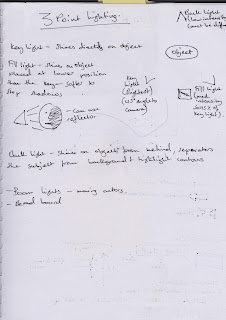 From the Caught In The Act project, the lighting was criticised heavily, therefore I looked into lighting and how to light my characters in scenes so that the lighting can reflect the mood I'm trying to create, as well as help frame the shot and focus on what I want the audience to look at.
I also looked into colour theory to also help reflect the mood I intend to set in my short film, however this will be used in post production mainly as we plan to slightly tint the film to a slightly blue shade, to reflect the trust and stability in the relationship between the characters, but also hint on the sadness and depression the characters are feeling.
 From previous projects I have found that my storyboards haven't been the best they could be, I looked into a few tutorials and basic symbols and signs that are followed to help make my storyboards more easy to read and follow on shoot. The tutorials have also helped with my time management and to create a shooting schedule and shot list to help use the time on shoot more effectively.
I looked into Propps character types


I also looked into colour theory to also help reflect the mood I intend to set in my short film, however this will be used in post production mainly as we plan to slightly tint the film to a slightly blue shade, to reflect the trust and stability in the relationship between the characters, but also hint on the sadness and depression the characters are feeling.

Tuesday, 19 April 2016
Questionnaire
Questionnaire - FMP from Synflame
We wrote a questionnaire in order to get other interpretations of crime within our target audience.
I found it a struggle to write the questionnaire as I wasn't sure what I wanted to be answered, and how to word the questions so there would be none of my biased opinion on the audience.
1. 3/10 NO 7/10 YES – only 3 shared what it was (when they were under the age of 7 – didn’t know right from wrong 2. 9/10 NO 1/10 – Depends 3. 2/10 NO 8/10 YES 4. dying/end of the world/ taking back rightfully theirs/ starving /needing to survive/ 4/10 said never 5. money/selfish/’no choice’/desperation/ peer pressure/ social / love 6. when you don’t need what you’re stealing/ the value of what you are stealing/ crisis/ hurting someone/ 2/10 unsure and 2/10 said never 7. London riots/ hatton garden x 3 / 4/10 said no 8. 3/10 yes 7/10 no 9. prison/ fine/community service/ 10 years/ depends x 2/make up value of what they took 10. depends/ happy (providing they get away with it)/ on edge/ guilty/ paranoid/ powerful 11. mask/ bald/ scar/ facial disfigurement/ rough/ dark clothing/ hoodie/ black/ teens – early 20s/ gang member
We wrote a questionnaire in order to get other interpretations of crime within our target audience.
I found it a struggle to write the questionnaire as I wasn't sure what I wanted to be answered, and how to word the questions so there would be none of my biased opinion on the audience.
1. 3/10 NO 7/10 YES – only 3 shared what it was (when they were under the age of 7 – didn’t know right from wrong 2. 9/10 NO 1/10 – Depends 3. 2/10 NO 8/10 YES 4. dying/end of the world/ taking back rightfully theirs/ starving /needing to survive/ 4/10 said never 5. money/selfish/’no choice’/desperation/ peer pressure/ social / love 6. when you don’t need what you’re stealing/ the value of what you are stealing/ crisis/ hurting someone/ 2/10 unsure and 2/10 said never 7. London riots/ hatton garden x 3 / 4/10 said no 8. 3/10 yes 7/10 no 9. prison/ fine/community service/ 10 years/ depends x 2/make up value of what they took 10. depends/ happy (providing they get away with it)/ on edge/ guilty/ paranoid/ powerful 11. mask/ bald/ scar/ facial disfigurement/ rough/ dark clothing/ hoodie/ black/ teens – early 20s/ gang member
What I learnt:
- Heavily reported news dictates what people know/remember
- Audience have harsh view of crime - possibly dictated by media coverage
- Audience are also unsure about how they feel - crime is a grey spectrum
I think it would be beneficial for this project to interview ourselves, as this project is about our own opinions
Sunday, 10 April 2016
Cleansed performance

Personally, I found this performance to be really confusing, I think that in order to understand what was going on I had to know about the performance beforehand. In terms of morality (the theme for my project), it relied on the doctor to help his obviously mentally ill patients, which he didn't as he force fed them and let one of them kill themselves.
For my own film I think I need to make it very clear to my audience about who the characters are (by perhaps only having a few character, or having clear binary oppositions), also I want to keep the storyline clear - as I don't want my audience to be confused and stop paying attention to my short film. Watching this performance has made me realise the importance of my screenplay and the cinematography - my short film needs to be clear and visual in terms of the plot and the characters.
Jury Service Stuff


I travelled to where the crime was committed for the first time after Jury Service and it was really interesting seeing the places in real life rather than photographs that I had seen for the duration of the trial. I think this put in perspective for me what it takes to commit a crime and the planning that must've gone on in order for this crime to take place, which in turn gave me inspiration for my film.
Subscribe to:
Posts (Atom)